What these games measure
Every test on this site produces one number and one comparison. The number is a raw measurement: milliseconds between a green flash and your click, clicks landed per second, words typed per minute, digits held in memory. The comparison is a percentile telling you roughly what share of people you would expect to beat.
Those numbers fall into two families. The speed tests (reaction time, click speed, aim and typing) measure how quickly your motor system converts an intention into a finished movement. Practice, equipment, and alertness all move these substantially. The memory tests (sequence, number, visual and chimp) measure working memory, the small amount of information you can hold and manipulate at once. Those move less with practice and more with strategy, which is why chunking is the recurring advice on every one of them.
Nothing here is a clinical instrument. A browser test running on your own hardware has real sources of noise: a 60 Hz display adds latency a 144 Hz display does not, a trackpad cannot register clicks as fast as a mouse switch, and being tired costs measurable performance on every task here. The results are still useful, because those sources of noise stay roughly constant for you. Tracking your own score over weeks tells you something real even when the absolute number would not survive laboratory conditions.
Every game at a glance
| Test | Typical score | What it measures |
|---|---|---|
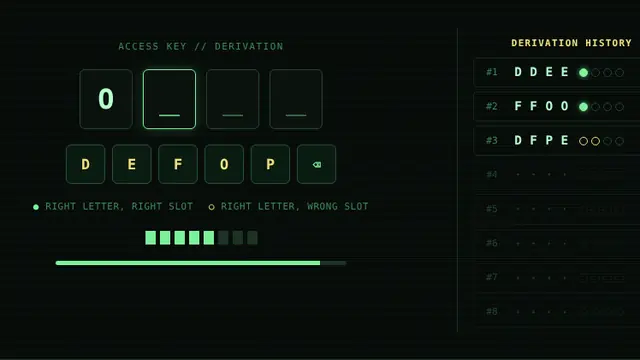
| Daily Word | 4 guesses | Vocabulary and deduction from letter-position feedback |
| Split Test | 85% | Visual estimation of area |
| Balance Point | 81% | Finding the centre of mass by eye |
| Color Match | Average ΔE: 10 | Color discrimination by eye |
| Reaction Time Test | 273ms | Simple visual reaction time, averaged over five attempts |
| Click Speed Test | 6.5 CPS | Sustained clicking rate over a chosen duration |
| Aim Trainer | 650ms | Speed and accuracy of cursor movement to a target |
| Typing Speed Test | 45 WPM | Net words per minute and typing accuracy |
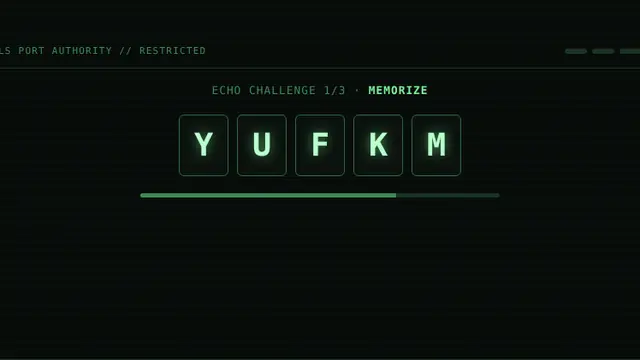
| Sequence Memory Test | level 9 | Spatial span: the longest ordered pattern you can repeat |
| Number Memory Test | 9 digits | Digit span: the longest number you can hold and recall |
| Visual Memory Test | level 9 | Visuospatial working memory for simultaneous positions |
| Chimp Test | 9 numbers | Working memory for numeral positions after masking |
| N-Back Test | Working memory that keeps updating as new items arrive | level 2.5 |
| Spacebar Speed Test | 6.5/s | Sustained spacebar presses per second |
| Dot Count | 85% | Approximate number sense |
| Hidden Clock | 600ms off | Internal timing of a ten second interval |
| Drift Test | 7 numbers | Tracking objects while holding their order |
| Stroop Test | Holding back the urge to read a word and naming its ink instead | 760 ms |
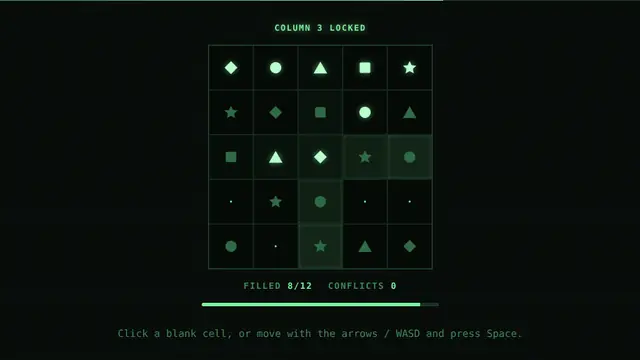
| Sudoku | Easy: ~7 min | Constraint logic across rows, columns and boxes |
| 2048 | Average best: 6,000 | Spatial planning and lookahead under a growing board |
| Word Search | 4 min | Visual search speed and pattern recognition |
| Minesweeper | Beginner: ~40s | Deductive reasoning under incomplete information |
| Snake | Average best: 220 | Path planning and spatial awareness under time pressure |
| Memory Match | 22 moves | Recognition memory and location recall for paired items |
| Solitaire | 8 min | Sequencing and planning across seven dependent piles |
| FreeCell | 6 min | Full-information planning across eight columns |
| Spider Solitaire | 1 suit: ~12 min | Long-horizon sequencing across ten columns |
How the percentile works
A raw score means very little on its own. Knowing that your reaction time is 265 milliseconds only becomes informative once you know that the adult median sits near 273, which makes 265 slightly above average rather than good or bad in isolation.
Each test here carries a distribution curve built from published score ranges for that task, anchored at a series of points and interpolated between them. Your result is placed on that curve to produce the percentage. It answers one specific question, what share of people you would expect to beat, and deliberately not a different one, which is how you rank against other visitors to this site. Site visitors are a self-selecting group who tend to retake tests until they get a good score, so ranking against them would flatter nobody honestly.
Two consequences worth knowing. Percentiles at the extremes are less reliable than percentiles in the middle, because the underlying data thins out. And a percentile on a 1 second click test is not comparable to one on a 60 second test, because they use separate curves for what are genuinely separate abilities.
Personal bests and privacy
Your best score for each test is written to your browser's local storage the moment you beat it. That storage lives on your device and is never transmitted anywhere. There is no account, no server-side scoreboard, and no way for anyone else to see your results unless you share them yourself.
The practical consequence is that scores do not follow you between devices, and clearing your browsing data clears them. If a personal best matters to you, the share card on the result screen produces an image you can keep.
Frequently asked questions
What is a human benchmark test?
It is a short, standardised task that produces a number you can compare against other people: reaction time in milliseconds, clicks per second, words per minute, or the length of a sequence you can hold in memory. The value comes from the comparison, which is why every test here reports a percentile alongside the raw score.
Are these tests scientifically accurate?
The tasks are modelled on real cognitive measures, but a browser running on your own hardware is not a controlled laboratory. Display refresh rate, input device, and how distracted you are all move the numbers. Treat the results as a consistent benchmark for tracking yourself over time rather than as an assessment.
How is the percentile calculated?
Each test uses a distribution curve derived from published score ranges for that task, and your result is interpolated against it. It answers what proportion of people you would expect to beat, not your rank against everyone who has used this site.
Do I need an account?
No. There is no login, no email, and no signup. Personal bests are stored in your browser's local storage, which means they stay on the device you played on and disappear if you clear site data.
Is it free?
Yes, entirely. The site runs on advertising and voluntary support. There is no paid tier and no test locked behind anything.